
In this guide
- Why Diwali smoke matters indoors
- Before Diwali: prepare your home
- Things You Need
- Step-by-Step Instructions
- During Diwali night
- After Diwali: the next few days
- Using an air purifier well
- Do plants, salt lamps or wet towels clean the air?
- Protecting children, elders and people with breathing problems
- Masks: what actually works
- Quick checklist
- Final word on protect your home from Diwali smoke
- FAQs
- Final Thoughts
The morning after Diwali, many Indian cities wake up to a grey haze. Smoke from crackers mixes with winter fog, vehicle exhaust and, in North India, crop-burning smoke, and the air quality index often shoots into the “poor” or “severe” range for days. You cannot control the air outside – but you can make the air inside your home noticeably cleaner with some simple steps. In this guide on protect your home from Diwali smoke, we keep everything simple and practical for Indian homes.
This guide explains how Diwali smoke gets into homes, what to do before, during and after the festival, how to use air purifiers well, and how to protect children, elders and anyone with breathing problems. It is based on general guidance from health and environmental bodies about reducing exposure to air pollution indoors. It is not medical advice – if anyone at home has asthma, heart or lung disease, follow their doctor’s plan.
Why Diwali smoke matters indoors
Cracker smoke contains fine particles (PM2.5 and PM10) and gases. PM2.5 particles are small enough to travel deep into the lungs. Because they are so fine, they easily drift into homes through open windows, gaps around doors and AC vents. On calm, cold nights the smoke stays close to the ground, which is why the air often feels worst late at night and early in the morning.
Before Diwali: prepare your home
- Service your air purifier: clean the pre-filter and check the main filter life. Replace it if the indicator says so – our best air purifiers in India guide explains filter life.
- Seal the gaps: check window and door gaps where you can feel air flowing. Simple draught strips or door snakes reduce how much smoke comes in.
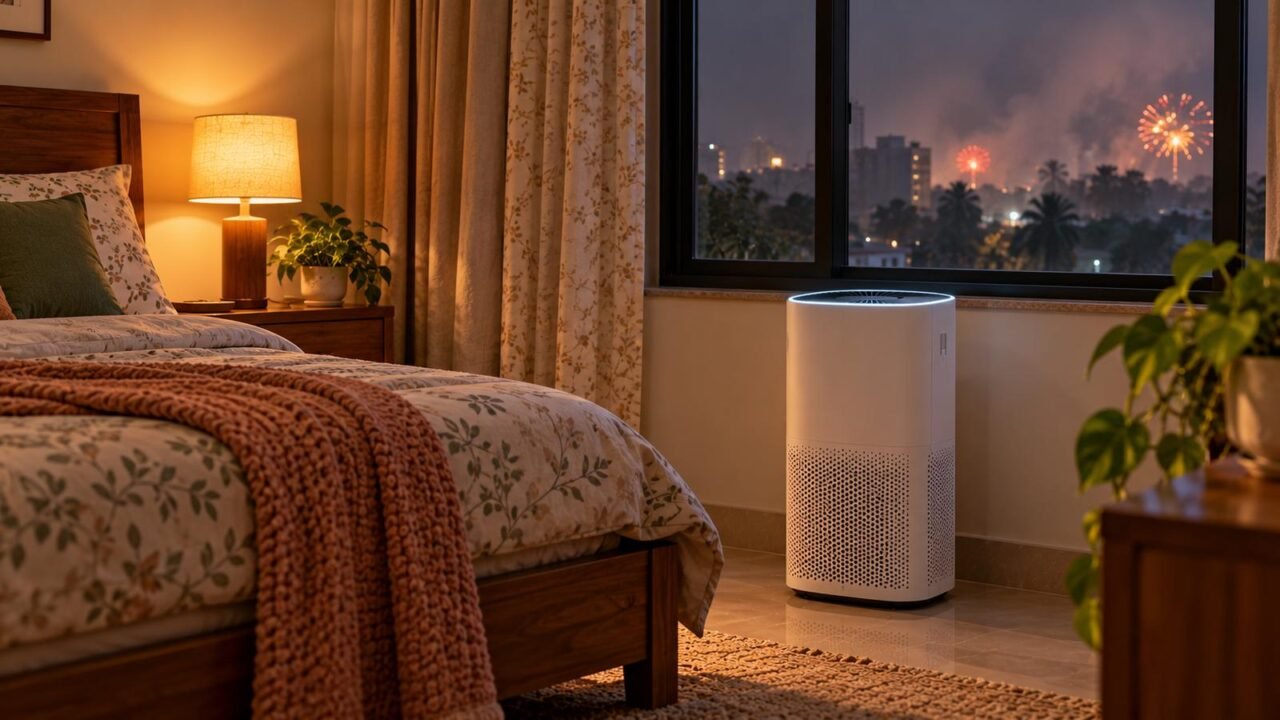
- Plan a “clean room”: choose one room – usually a bedroom – that you will keep closed with an air purifier running on the worst nights, especially for children, elders and anyone unwell.
- Stock up: keep well-fitting N95 or N99 masks for anyone who must step outside, and any regular medicines (such as inhalers) that family members use.
- Check the AQI forecast: government and private apps show forecasts, so you know which days to plan for.
Things You Need
- HEPA air purifier sized for the room
- Spare or new purifier filter if due
- Draught strips or door snakes
- N95 or N99 masks
- AQI app
Step-by-Step Instructions
-
Step 1: Prepare the purifier
Clean the pre-filter, check the filter-life indicator and replace the main filter if needed before Diwali.
-
Step 2: Set up a clean room
Choose a bedroom, seal obvious gaps around windows and doors, and place the purifier with space around it.
-
Step 3: Close up on Diwali night
Shut windows and doors when crackers start, run the purifier on high and keep the AC on recirculation.
-
Step 4: Limit indoor smoke
Reduce incense, dhoop and candles indoors on high-pollution nights.
-
Step 5: Clean and ventilate after
Open windows briefly when AQI improves, wet-mop floors, damp-wipe surfaces and clean purifier pre-filters.
During Diwali night
- Close windows and doors when crackers start, especially facing streets and parks where people burst them.
- Run the air purifier on high in the clean room with the door shut. If you have more than one, run one in each bedroom.
- Use the AC on recirculation (if you use it) rather than fresh-air mode, and keep balcony doors closed.
- Turn off exhaust fans and chimneys that pull outdoor air in through other gaps, once cooking is done.
- Keep indoor smoke low: limit incense, dhoop and candles indoors on high-pollution nights; diyas in moderation, with ventilation once the outside air improves.
- Stay indoors during peak cracker hours if anyone at home is sensitive to smoke.
After Diwali: the next few days
- Ventilate at the right time: check the AQI and open windows briefly when it is lower – often in the afternoon when the sun has warmed the air. Close them again in the evening.
- Clean surfaces: fine dust and ash settle on floors, sills and furniture. Wet-mop floors and wipe surfaces with a damp cloth instead of dry dusting or sweeping, which throws particles back into the air.
- Vacuum with a HEPA filter if you have one; see our best vacuum cleaners guide.
- Clean purifier pre-filters again after heavy use.
- Wash curtains and cushion covers if they smell of smoke.
Using an air purifier well
An air purifier helps only if it is the right size and used in a closed room:
- Match the CADR to the room size – roughly 200 m³/h for a 150–180 sq ft bedroom. Our guide on how to choose an air purifier explains the numbers.
- Choose a True HEPA filter (H13 or better) plus activated carbon, which helps with smoke smell.
- Keep doors and windows closed while it runs, and place it with space around it.
- Run it on high for the first hour, then on auto or medium.
A popular example is the Philips 900 Series, which lists a CADR of 250 m³/h.
Do plants, salt lamps or wet towels clean the air?
Indoor plants make a room pleasant, but you would need a very large number of them to match even a small air purifier for removing PM2.5. Salt lamps and “ionising” gadgets are not proven to clean smoke from the air, and devices that produce ozone can irritate the lungs. Hanging wet cloths may trap a little dust but adds humidity and does not replace filtration. Closing up the home and using a proper HEPA purifier are the reliable steps.
Protecting children, elders and people with breathing problems
- Keep them in the clean room with the purifier during peak smoke hours.
- Avoid outdoor exercise, morning walks and outdoor play when the AQI is poor; move activity indoors.
- If they must go out, use a well-fitting N95 or N99 mask; cloth and surgical masks offer much less protection against fine particles.
- Keep regular medicines and inhalers handy and follow the doctor’s action plan.
- Watch for warning signs – breathlessness, chest tightness, persistent cough or wheezing – and seek medical help if they appear.
Masks: what actually works
| Mask | Protection against fine smoke particles |
|---|---|
| N95 / N99 (well-fitting) | Good, if it seals around the nose and chin |
| Surgical mask | Limited – gaps at the sides |
| Cloth mask or handkerchief | Very limited |
Masks with valves are easier to breathe through but do not filter the air you breathe out. Replace disposable masks when they become hard to breathe through, dirty or damaged.
Quick checklist
| Before | During | After |
|---|---|---|
| Service purifier, check filter | Close windows and doors | Ventilate only when AQI drops |
| Seal gaps | Purifier on high in clean room | Wet-mop and damp-wipe |
| Plan a clean room | AC on recirculation | Clean pre-filters |
| Masks and medicines ready | Limit indoor smoke | Wash smoky fabrics |
Also see our Diwali electrical safety tips for a safe festival at home.
Final word on protect your home from Diwali smoke
We review this guide on protect your home from Diwali smoke regularly as models and listings change. Always check the latest details on the product page before you buy, and see official information on CPCB (Central Pollution Control Board).
Frequently Asked Questions
1. How long does Diwali pollution last?
It depends on the weather. On calm, cold days, smoke can linger for several days, especially in North India where it mixes with winter fog and crop-burning smoke. Check the AQI daily.
2. Do air purifiers help with Diwali smoke?
Yes, a correctly sized HEPA purifier with an activated carbon layer can significantly reduce smoke particles indoors when windows and doors are closed.
3. Should I open windows after Diwali?
Only when the outdoor AQI improves, often in the afternoon. Keep windows closed when the air is heavy with smoke, especially at night and early morning.
4. Which mask is best for Diwali smoke?
A well-fitting N95 or N99 mask that seals around the nose and chin. Cloth and surgical masks give much less protection against fine particles.
5. Do indoor plants reduce Diwali pollution?
Plants make rooms pleasant but cannot remove PM2.5 smoke at any meaningful rate. A HEPA air purifier in a closed room is far more effective.
Final Thoughts
You cannot control the smoke outside on Diwali night, but you can keep the air inside much cleaner. Prepare your purifier, create a closed clean room, keep windows shut during cracker hours, ventilate only when the AQI drops, and clean with damp methods afterwards. Protect children, elders and anyone with breathing problems first.