
In this guide
- Our Top Picks
- Quick picks
- First, pick the right type of heater
- How many watts does your room need?
- Our picks in detail
- What to check before you buy
- How much will it add to your electricity bill?
- Safety basics for any room heater
- Best room heater for babies and elderly parents
- Related guides
- Final word
- FAQs
- Final Verdict
Key Takeaways
- Choose the heater type first: OFR for long nights in big rooms, fan heater for quick heat, quartz for one person or a small room.
- Plan about 1,000 W for every 100–120 sq ft of room.
- A thermostat and overheat protection save power and make any heater safer.
- Plug heaters directly into a 16 A wall socket – never into an extension board.
Our Top Picks
-
Best Overall
Havells 13 Fin Oil Filled Room Heater (Hestio)
- 1000/1500/2500 W + 400 W PTC fan
- Thermostat, overheat protection
- Retractable wheels, angled controls
-
OFR Alternative
Morphy Richards OFR 13F Oil Filled Radiator
- 2500 W + 400 W PTC fan
- Adjustable thermostat, safety shut-off
- Castor wheels
-
Best Fan Heater
Orient Electric Areva Fan Room Heater
- 1000 / 2000 W modes
- Overheat protection
- Stands upright or lies flat
-
Best Budget
Amazon Brand Solimo 2000/1000 W Room Heater
- Adjustable thermostat
- ISI certified (as listed)
- Small to medium rooms
-
Best for Small Rooms
Usha 4302 2-Rod Quartz Heater
- 400 / 800 W settings
- Tip-over protection
- Cool-touch body
-
Best Convector
Usha 423N 2000 W Heat Convector
- 2000 W convector
- Overheat protection
- Cool-touch handle, ISI (as listed)
The first cold night of the season usually sends someone in the house looking for the old heater in the loft. Sometimes it still works. Often it smells of burnt dust, trips the MCB, or warms only the one person sitting right in front of it. If you are buying a new room heater this winter, the good news is that you do not need to spend a lot. You just need the right type for your room.
We compared popular room heaters sold on Amazon India – oil-filled radiators, fan heaters, a convector and a quartz heater – using the brand listings, product specifications and safety features. We have not tested these heaters in our own homes, so we do not give scores. Instead, we explain what each type does well, where it falls short, and which kind of home it suits.
Last reviewed: November 2026 by the BestHomeLivingGuide Team. We compare brand specifications, retailer listings and verified buyer feedback – read our editorial policy to see how we research.
Quick picks
| Heater | Type | Power (as listed) | Key safety feature | Best for |
|---|---|---|---|---|
| Havells 13 Fin OFR (Hestio) | Oil-filled radiator + 400 W fan | 1000 / 1500 / 2500 W + 400 W PTC | Thermostat, overheat protection | Large bedrooms, homes with babies or elders |
| Morphy Richards OFR 13F | Oil-filled radiator + 400 W fan | 2500 W + 400 W PTC | Thermostat, safety shut-off | Long nights in a closed room |
| Orient Electric Areva | Fan heater | 1000 / 2000 W | Overheat protection | Quick heat in small to medium rooms |
| Amazon Brand Solimo 2000 W | Fan heater | 1000 / 2000 W | Adjustable thermostat, ISI mark | Tight budgets |
| Usha 4302 Quartz | 2-rod quartz | 400 / 800 W | Tip-over protection | Small rooms, study tables, low power use |
| Usha 423N Convector | Convector | 2000 W | Overheat protection | Medium rooms, quieter heating |
Specifications are taken from Amazon India listings at the time of writing. Sellers sometimes change details, so check the exact model, wattage and warranty on the product page before you buy.
First, pick the right type of heater
Most heater regret comes from buying the wrong type, not the wrong brand. Here is how the four common types behave in a real Indian home.
Oil-filled radiators (OFR)
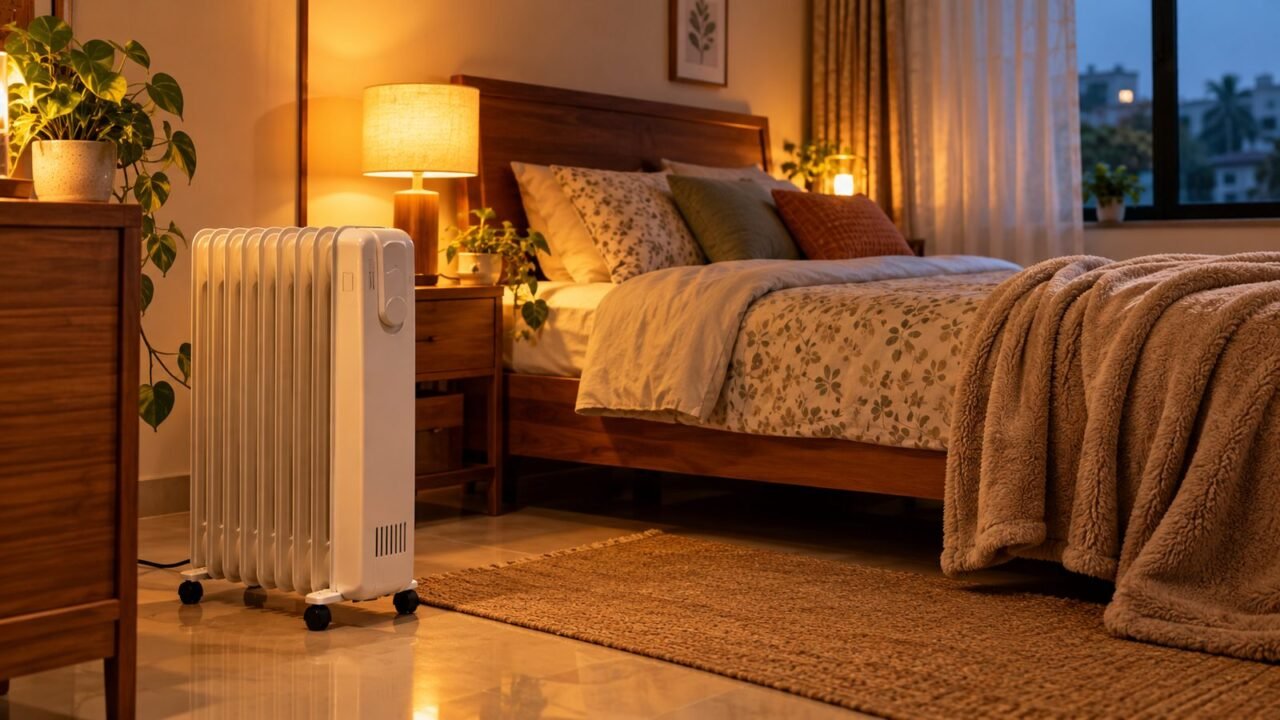
An OFR heats sealed oil inside metal fins, and the fins slowly warm the whole room. It takes 15 to 30 minutes to feel the difference, but once the room is warm it stays warm, and the heat feels gentle rather than harsh. There is no glowing element and no fan noise on the main setting, which is why many families keep one in a bedroom for the whole night. The downsides: OFRs are heavy, cost more, and draw up to 2,500 W or more on the highest setting.
Fan heaters
A fan heater blows air over a hot element. It warms a small room in a few minutes, it is light enough to carry from room to room, and it is the cheapest type to buy. It also makes a steady fan noise and the air can feel dry after a few hours. Fan heaters work best for short sessions – getting ready in the morning, an hour before bed, or a cold study room.
Convectors
A convector heats the air around its element and lets it rise naturally, sometimes with a small fan to help. It sits between a fan heater and an OFR: faster than an OFR, quieter than most fan heaters, and usually cheaper than both OFR picks here.
Quartz and halogen heaters
These glowing-rod heaters warm the person in front of them rather than the air in the room, a bit like sitting in the sun. They use little power (400–800 W for two rods) and start working instantly. They are a good choice for one person at a desk or a small room, but they will not warm a large bedroom. Keep them well away from curtains, bedsheets and children.
How many watts does your room need?
A simple rule that works for most Indian homes: plan for about 1,000 W for every 100–120 sq ft of room, and a little more if the room has a large window, a high ceiling or sits on the top floor.
| Room size | Suggested heater |
|---|---|
| Up to 100 sq ft (study, small bedroom) | 800 W quartz or a 1000 W fan setting |
| 100–180 sq ft (normal bedroom) | 2000 W fan heater or convector, or a 9–11 fin OFR |
| 180–250 sq ft (master bedroom, small hall) | 13 fin OFR (2500 W class) |
These are rough guides, not exact numbers. Insulation, the outdoor temperature in your city and how tightly the doors close all change how fast a room warms up.
Our picks in detail
1. Havells 13 Fin OFR (Hestio) – best overall for large rooms
Check Havells 13 Fin OFR on Amazon
If you want one heater that can stay on through a cold night in a big bedroom, a 13-fin OFR is the sensible choice, and this Havells model covers the basics well. The listing gives three heat settings (1000, 1500 and 2500 W), a thermostat that lets the heater switch itself on and off around the temperature you choose, and a separate 400 W PTC fan heater for when you want the room warm quickly.
Small design details matter with a heavy appliance like this. The control panel is angled so you do not have to bend down to read it, the handle folds into the body, and the wheels retract when you are not moving it. Havells lists overheat protection and a cool-touch exterior as features, and the listing mentions conformity with IS 302-2-30, the Indian safety standard for room heaters.
- Good for: master bedrooms, homes with small children or elderly parents, people who dislike fan noise.
- Keep in mind: it is heavy and slow to heat on its own. Use the fan for the first 15 minutes, then switch to the oil heater with the thermostat. The listing title mentions a 10-year warranty linked to the fins – read the warranty card to see exactly what it covers.
2. Morphy Richards OFR 13F – a long-running OFR alternative
Check Morphy Richards OFR 13F on Amazon
The Morphy Richards OFR 13F has been on the market for years, which usually means service centres and spare parts are easy to find. Like the Havells, it is a 13-fin radiator rated at 2900 W in total – 2500 W from the oil heater plus a 400 W PTC fan. It has an adjustable thermostat, a safety shut-off and castor wheels.
Choose between the two OFRs based on the final price, the warranty you get on the day, and which brand has better service in your town. Functionally, they solve the same problem.
- Good for: anyone who wants a proven OFR design for long, cold nights.
- Keep in mind: on the highest setting it draws close to 3 kW, so plug it directly into a 16 A socket, not a multi-plug extension.
3. Orient Electric Areva – best fan heater
Check Orient Electric Areva on Amazon
The Areva is one of the most reviewed fan heaters on Amazon India, with more than ten thousand ratings at the time of writing. It has two heat modes (1000 W and 2000 W), overheat protection, and can be used either standing upright or lying flat – handy if you want to point it at your feet under a desk.
For a small or medium bedroom, a fan heater like this warms the air within minutes, which is exactly what you want on a cold morning when you are getting ready for work or school. Switch it off once the room is comfortable instead of running it for hours.
- Good for: quick heating in rooms up to about 150 sq ft, families who move the heater between rooms.
- Keep in mind: fan noise is noticeable at night, and the listing does not mention a thermostat, so it will keep heating until you turn it off or down.
4. Amazon Brand Solimo 2000/1000 W – best budget pick
Check Solimo 2000 W Room Heater on Amazon
If you only need a heater for a few weeks of real cold, the Solimo fan heater keeps things simple. It has two power levels, carries the ISI mark according to the listing, and – unusually for a heater at this price – an adjustable thermostat. That thermostat matters more than it sounds: instead of running flat out, the heater cuts off when the room reaches your setting, which saves power and stops the room from getting stuffy.
- Good for: students, rented rooms, small bedrooms and first-time buyers.
- Keep in mind: it is a basic plastic-bodied fan heater. Do not cover it, and keep it on a hard floor rather than a rug or bed.
5. Usha 4302 2-Rod Quartz – best for small rooms and low power
Check Usha 4302 Quartz Heater on Amazon
Not every room needs a 2000 W heater. If you sit at one desk for a few hours, or your bedroom is small, a quartz heater uses far less power. The Usha 4302 has two rods with 400 W and 800 W settings, a cool-touch body and tip-over protection, which switches the heater off if it falls. That last feature is worth insisting on in any rod heater.
- Good for: study tables, small rooms, homes on a low-load electricity connection.
- Keep in mind: it warms what is in front of it, not the whole room. Keep at least a metre of space around it, and never use it to dry clothes.
6. Usha 423N Convector – a quieter middle ground
Check Usha 423N Convector Heater on Amazon
Convectors are often overlooked, but they suit people who find fan heaters too noisy and OFRs too slow or expensive. The Usha 423N is a 2000 W heat convector with overheat protection, a cool-touch handle and an ISI mark, according to the listing. It warms a medium bedroom more evenly than a rod heater and faster than an oil heater.
- Good for: medium bedrooms and living rooms used in the evening.
- Keep in mind: like any 2000 W heater it adds up on your bill if you leave it on for hours. Use it with a timer plug or switch it off once the room is warm.
What to check before you buy
- Thermostat: lets the heater hold a set temperature instead of running non-stop. It saves power and keeps the room comfortable.
- Overheat protection: cuts power if the heater gets too hot, for example if a towel falls on it.
- Tip-over switch: essential for rod and fan heaters in homes with children or pets.
- ISI mark: room heaters sold in India should meet BIS safety standards. Look for the ISI mark on the product and the box.
- Plug and wire: heaters above about 1500 W need a 16 A socket. Check the cord length so you are not tempted to use an extension board.
- Weight and wheels: an OFR can weigh 10 kg or more. Wheels and a good handle make a real difference.
- Warranty and service: check the warranty card and whether the brand has a service centre in your city.
How much will it add to your electricity bill?
You can estimate the cost yourself. A heater’s power in kilowatts multiplied by the hours it runs gives you the units (kWh) it uses. A 2000 W heater running for 3 hours uses about 6 units. Multiply that by the per-unit rate on your electricity bill. If your tariff is ₹7 per unit, that is about ₹42 for the evening.
A thermostat lowers the real figure because the heater switches off once the room is warm. An OFR on its middle setting with the thermostat set sensibly will often use less than its full rating over a night. Quartz heaters use the least power but also heat the smallest area.
Safety basics for any room heater
- Plug the heater straight into a wall socket of the right rating. Avoid extension boards and multi-plugs.
- Keep at least one metre of clear space from curtains, bedding, sofas and clothes.
- Never dry clothes or towels on a heater.
- Do not leave rod or fan heaters running while everyone is asleep. If you need overnight heat, an OFR with a thermostat is the safer type.
- Keep a little ventilation in the room. Electric heaters do not burn oxygen, but a sealed, overheated room feels stuffy and dry. A bowl of water nearby can help with dryness.
- Switch off and unplug the heater when you leave the room.
Shopping for winter hot water too? Read our guide to the best geysers in India and our explainer on instant vs storage geysers.
Best room heater for babies and elderly parents
For a baby’s room or for elderly parents, an oil-filled radiator is usually the safest pick: it has no glowing element, does not blow hot air directly and keeps the room evenly warm. Its surface still gets hot, so place it where a child cannot touch it, keep it at least one metre from the bed and curtains, and choose a model with overheat protection. Keep a window slightly open and use a humidifier if the air feels dry.
Related guides
- Oil-filled vs fan vs halogen heater: which to buy?
- Room heater safety tips for Indian homes
- How to reduce your electricity bill in winter
- Best humidifiers in India (for dry winter air)
- Best geysers in India
Final word
Choose the type first, then the model. For a large bedroom where the heater stays on for hours, an oil-filled radiator such as the Havells 13 Fin OFR or the Morphy Richards OFR 13F is the comfortable, safer option. For quick heat in a small or medium room, the Orient Electric Areva or the budget Solimo do the job. If you only need warmth at a desk or in a tiny room, the Usha 4302 quartz heater uses the least power, and the Usha 423N convector is a quiet middle ground. Whatever you buy, use a proper wall socket and keep fabrics well away.
Frequently Asked Questions
1. Which type of room heater is best for a bedroom?
For a bedroom where the heater runs for several hours, an oil-filled radiator with a thermostat is the most comfortable and safest type. It heats slowly but evenly, makes little noise and has no glowing element. For short sessions in a small bedroom, a fan heater or convector is enough.
2. Does an oil heater consume less electricity than a fan heater?
Not by itself – a 2000 W heater uses 2 units an hour whether it is an OFR or a fan heater. An OFR often uses less over a long night because it holds heat and its thermostat switches it off more often. For short use, a fan heater can cost less because it warms the room quickly and you switch it off sooner.
3. Is it safe to sleep with a room heater on?
It is safest with an oil-filled radiator that has a thermostat and overheat protection, placed well away from bedding and plugged directly into a wall socket. Avoid leaving rod or fan heaters on while everyone sleeps. Keep a little ventilation in the room.
4. What size room heater do I need?
A rough guide is about 1,000 W for every 100–120 sq ft. An 800 W quartz heater suits a study corner or a very small room, a 2000 W fan heater or convector suits a normal bedroom, and a 13-fin OFR suits a large bedroom.
5. Do room heaters reduce oxygen in the room?
Electric heaters do not burn oxygen. The heavy or stuffy feeling comes from warm, dry air in a closed room. Keep a door or window slightly open for ventilation and keep a bowl of water nearby if the air feels dry. Gas heaters are different and need proper ventilation.
6. Can I use a room heater with an extension board?
It is not recommended. Most heaters draw 1500–2900 W, which can overheat ordinary extension boards and thin wires. Use a 16 A wall socket in good condition.
Final Verdict
Pick the type before the brand. For large bedrooms and long nights, choose an oil-filled radiator such as the Havells 13 Fin OFR or the Morphy Richards OFR 13F. For quick heat in a small or medium room, the Orient Electric Areva or the budget Solimo fan heater work well. For one person or a tiny room, the Usha 4302 quartz heater uses the least power, and the Usha 423N convector is a quiet middle ground.