
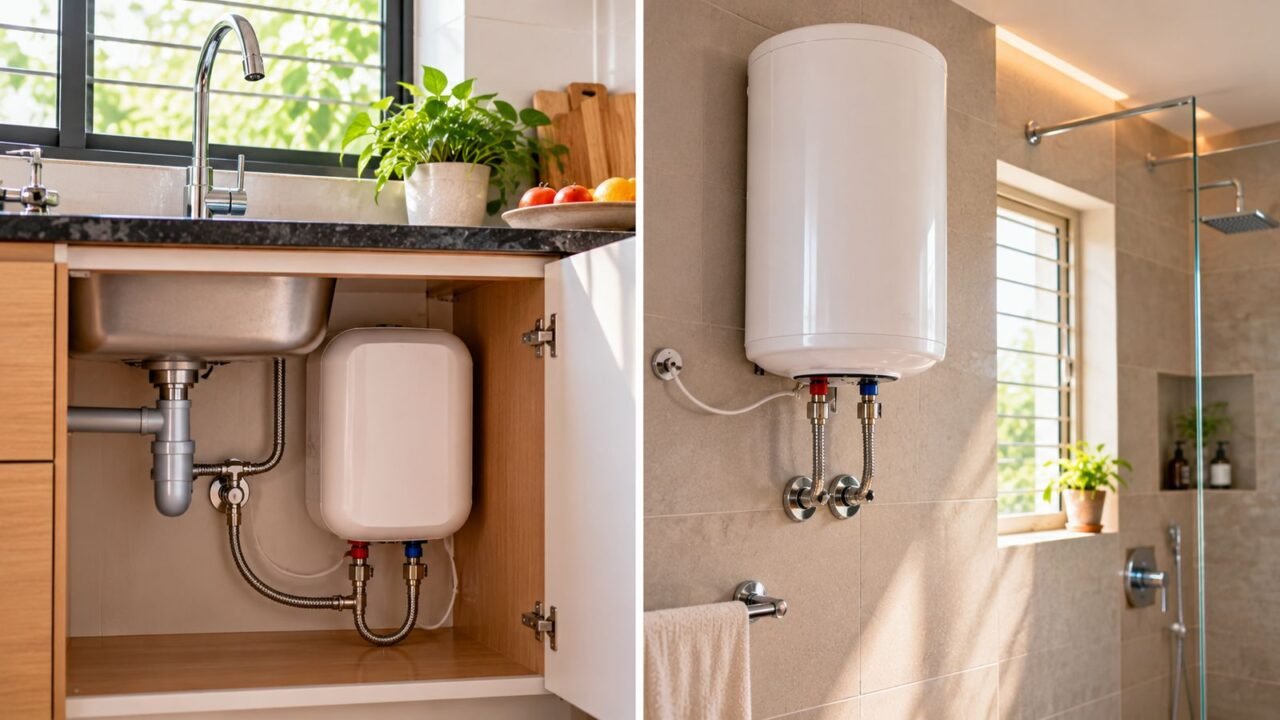
Walk into any appliance store before winter and the first question you will hear is: instant or storage? Both heat water, but they solve different problems. An instant geyser gives you a little hot water quickly. A storage geyser heats a full tank so the whole family can bathe. Pick the wrong one and you will either wait every morning or pay for a big tank you never fill.
This guide explains how each type works, where each one makes sense in an Indian home, and how to choose the right size for your family and bathroom. It also covers the wiring and safety checks people often forget until the installer arrives.
Things You Need
- Measuring tape (wall space above the tap)
- Number of people and their bathing routine
- Your building type (independent house or high-rise)
- Your electrician's advice on the socket and wiring
- Your last electricity bill
Step-by-Step Instructions
-
Step 1: Decide where you need hot water
List each place: main bathroom, second bathroom, kitchen, washbasin. Bathing needs a steady supply of hot water for several minutes, so it usually needs a storage geyser. The kitchen and washbasin need small amounts at a time, which suits an instant geyser. Many homes end up with a storage geyser in each bathroom and one instant geyser in the kitchen.
-
Step 2: Understand how each type works
A storage geyser heats a tank of water and keeps it hot with insulation, so you can use a full bucket or a shower at once. An instant geyser has a small tank of 1–3 litres and a powerful element that heats it quickly. Once the small tank is used up, you wait for the next batch. Despite the name, most "instant" electric geysers sold in India are small, fast-heating storage units, not true tankless heaters.
-
Step 3: Count people and bathing habits
Think about who bathes, when and how. As a rough guide: 10–15 litres suits one or two people using a bucket; 15–25 litres suits three or four people sharing one bathroom; 25 litres or more suits larger families, back-to-back baths or long showers. If family members bathe at different times, a smaller tank has time to reheat in between, so you can go one size down.
-
Step 4: Measure the space and choose the mounting
Measure the wall above or near the tap, including the height to the ceiling. Vertical storage geysers need more height; horizontal models fit wider, shorter spaces, such as above a door or below a false ceiling. Note which side your pipes come out of – some models come in left-hand and right-hand versions. Leave space for the technician to service the geyser later.
-
Step 5: Check your water pressure
Independent houses fed by an overhead tank usually have low pressure. High-rise apartments often use pressure pumps, which push higher pressure into the geyser. If you live in a tall building, choose a geyser rated for 8 bar and ask the installer to fit the multi-function safety valve supplied with it.
Safety note: Never remove, block or plug the safety valve. It releases excess pressure and protects the tank from bursting.
-
Step 6: Check the wiring and socket
A storage geyser typically uses about 2000 W, while instant geysers commonly use 3000 W or more. Higher wattage means higher current, so the socket, wire size and circuit breaker must be rated for it. Ask an electrician to check the circuit before installing an instant geyser, especially in older homes. Proper earthing is essential for both types, and an RCCB on the bathroom circuit adds protection against electric shock.
Safety note: Do not run any geyser on an extension board or a socket without earthing.
-
Step 7: Compare running costs
For storage geysers, look at the BEE star label – the rating is based on standing loss, how much heat the tank loses in 24 hours. A 5-star model loses less heat and reheats less often. Instant geysers draw more power while heating but heat only a small amount of water. For bathing, a well-insulated storage geyser used sensibly is usually the efficient choice; for small kitchen jobs, an instant geyser avoids heating a whole tank.
-
Step 8: Check tank protection and warranty
In hard-water areas, the tank coating and the magnesium anode decide how long a storage geyser lasts. Look for glass-lined, titanium enamel or a similar coating, and compare the tank warranty. For instant geysers, a stainless steel or well-coated inner tank resists rust. Make sure the geyser carries the BIS standard mark (ISI), and keep the GST invoice for warranty claims.
Instant vs storage at a glance
| Point | Instant geyser | Storage geyser |
|---|---|---|
| Typical capacity | 1–3 litres | 10–25 litres or more |
| Typical power | 3000–4500 W | About 2000 W |
| Heating time | A few minutes | Longer – depends on tank size and the inlet water temperature |
| Hot water at one time | Small amount; then wait for it to reheat | A full tank, enough for one or more baths |
| Best for | Kitchen, washbasin, one person with a bucket | Bathing, families, showers |
| Space | Compact; fits under a sink or in a corner | Needs more wall space; vertical or horizontal models |
| Wiring | Needs a socket and wiring rated for its higher current | Normal geyser point with earthing |
| BEE star label | Not usually star-rated | Star rating based on standing heat loss |
Common mistakes
- Buying an instant geyser for a family bathroom. It saves money at the shop but leads to cold-water waits every morning.
- Buying the biggest tank “just in case”. A 25-litre tank used by one person wastes electricity heating water no one uses.
- Ignoring building water pressure. In high-rise flats with pressure pumps, a low-pressure model can leak or fail early.
- Forgetting the wiring. A 3000 W instant geyser on an old, thin wire is a fire risk.
- Skipping the safety valve. Some installers leave out the multi-function valve to save time. Insist on it.
Real-life examples
A couple in a 1BHK flat
One bathroom, two people, bucket baths at different times. A 10–15 litre storage geyser is enough. If there is no space for a vertical tank above the tap, choose a horizontal model. Add a small instant geyser in the kitchen only if you wash a lot of vessels in winter.
A family of four in a 2BHK apartment
Two bathrooms, morning rush, building with a pressure pump. A 15-litre, 8-bar storage geyser in the main bathroom and a 10–15 litre unit in the second bathroom works well. If everyone uses the main bathroom one after another, consider 25 litres there.
A joint family in an independent house
Several people bathing in the morning and evening, often with a shower. Choose 25 litres or more for the main bathroom. Water pressure from an overhead tank is usually low, but check the tank height and whether you use a booster pump.
Kitchen only
For washing vessels and hands, a 3-litre instant geyser is the right tool. It heats quickly, takes little space and does not need a big tank.
Maintenance: what each type needs
Both types need the same basics: proper earthing, a working thermostat and a safety valve that is never blocked. Storage geysers need a little more care because they hold water all the time. In hard-water areas, scale builds up on the heating element and the magnesium anode slowly wears away as it protects the tank. A yearly service lets the technician check the anode, replace it when needed and descale the element. Havells’ manual, for example, advises checking the anode every year.
Instant geysers have smaller tanks, but scale still collects on their powerful elements, and a scaled element takes longer to heat. If the water starts taking longer to warm up, or you hear crackling while it heats, book a service. For both types, call the brand’s service centre if you notice leaks, rust-coloured water or a burning smell, and switch the geyser off until it is checked.
What about gas and solar geysers?
Gas geysers heat water as it flows, so they suit homes with a piped gas supply. They must be installed with proper ventilation, because burning gas in a closed bathroom can be dangerous. Solar water heaters work well in sunny regions and can cut electricity bills sharply, but they need roof space, a larger upfront cost and usually an electric backup for cloudy days. For most flats, an electric storage geyser is still the simplest choice.
Ready to buy? Our guide to the best geysers in India compares storage and instant models from Racold, AO Smith, Havells and Crompton.
Frequently Asked Questions
1. Which is better, instant or storage geyser?
Neither is better for every home. A storage geyser is better for bathing because it holds enough hot water for a full bath. An instant geyser is better for the kitchen or a washbasin, where you need small amounts of hot water quickly.
2. Which size geyser do I need for a family of four?
A 15–25 litre storage geyser suits most families of four sharing one bathroom. Choose 15 litres if you use buckets and bathe at different times. Choose 25 litres if you use a shower or several people bathe one after another.
3. Does an instant geyser use more electricity?
An instant geyser draws more power while it is heating, but it heats only a small amount of water. Your bill depends on how much hot water you use and for how long the heater runs. For bathing a family, a well-insulated 5-star storage geyser used sensibly is usually more economical.
4. Can I install an instant geyser in the bathroom?
Yes, if it is meant for a washbasin or a single person who bathes with a bucket and does not mind waiting for the water to reheat. For regular bathing by several people, a storage geyser is more practical.
5. Is a 10-litre geyser enough?
A 10-litre storage geyser can be enough for one or two people who bathe with a bucket at different times. For a family sharing one bathroom, 15 litres or more is usually more comfortable.
6. Do I need an 8-bar geyser?
You need an 8-bar geyser if your building uses a pressure pump or you live on a lower floor of a tall building, where water pressure is higher. In an independent house with an overhead tank, the pressure is usually low, but an 8-bar model is still a safe choice.
Final Thoughts
Choose a storage geyser for bathing and an instant geyser for the kitchen. Size the storage tank to your family's routine – 15 litres for most families of three or four, 25 litres or more for showers and back-to-back baths. Check the space, the water pressure and the wiring before you buy, and never let the installer skip the safety valve. With the right type and size, you will have hot water when you need it without paying to heat water you never use.