
In this guide
- The quick answer
- Oil filled vs fan heater vs halogen: side-by-side comparison
- Things You Need
- Step-by-Step Instructions
- Oil-filled radiators: slow, steady and gentle
- Fan heaters: fast heat for short sessions
- Halogen and quartz heaters: personal heat, low power
- Which one should you buy? Pick your situation
- What about the electricity bill?
- Three common myths
- Safety, whichever type you choose
- Best heater type for a small room
- Related guides
- FAQs
- Final Thoughts
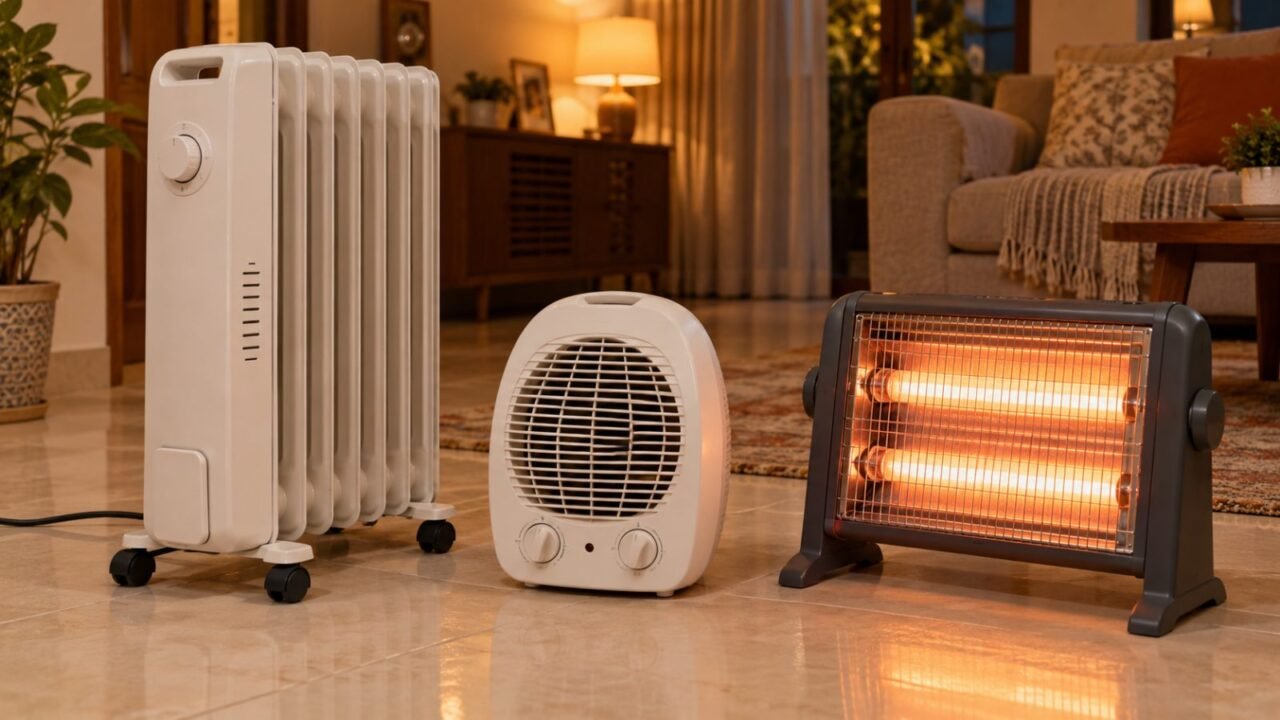
Walk into any electronics shop in November and you will see three kinds of room heaters lined up: chunky oil-filled radiators, small fan heaters and glowing rod heaters. The salesperson will usually push whichever one has the best margin that week. The truth is simpler. Each type is good at one job and poor at another, and once you know which job you need done, the choice almost makes itself.
This guide compares oil-filled radiators (OFR), fan heaters and halogen or quartz heaters on the things that matter in an Indian home: how fast they heat, how big a room they can handle, noise, electricity use, safety and comfort. It is based on how each type works and on manufacturer specifications. We have not measured these heaters ourselves.
Last reviewed: November 2026 by the BestHomeLivingGuide Team. We compare brand specifications, retailer listings and verified buyer feedback – read our editorial policy to see how we research.
The quick answer
- Oil-filled radiator: best for bedrooms where the heater runs for hours, especially at night, and for homes with babies or elderly people.
- Fan heater: best for warming a small or medium room quickly for an hour or two.
- Halogen or quartz heater: best for warming one person at a desk or in a very small room, using the least power.
Oil filled vs fan heater vs halogen: side-by-side comparison
| Oil-filled radiator | Fan heater | Halogen / quartz | |
|---|---|---|---|
| How it heats | Heats oil in sealed fins; fins warm the air slowly | Fan blows air over a hot element | Glowing rods send out radiant heat in one direction |
| Time to feel warm | 15–30 minutes | 2–5 minutes | Instant, but only in front of it |
| Room size | Medium to large | Small to medium | Small / personal |
| Typical power | 2000–2900 W (with fan) | 1000–2000 W | 400–1200 W |
| Noise | Silent (fan optional) | Steady fan noise | Silent |
| Feels dry? | Least | Most | Moderate, mostly on skin facing it |
| Surface risk | Fins get hot but no exposed element | Grille gets warm | Exposed glowing rods behind a guard |
| Weight | Heavy (needs wheels) | Light | Light |
| Buying cost | Highest | Lowest | Low |
Things You Need
- Room size in sq ft
- How many hours a day you need heat
- Socket rating where the heater will be used (16 A for 1500 W+)
Step-by-Step Instructions
-
Step 1: Decide how long the heater will run
If you need heat for less than an hour or two at a time, a fan heater is usually enough. If the heater will stay on for most of the night, choose an oil-filled radiator with a thermostat.
-
Step 2: Measure the room
Small rooms and single desks suit a quartz or halogen heater. Normal bedrooms suit a 2000 W fan heater or a 9–11 fin OFR. Large bedrooms need an 11–13 fin OFR.
-
Step 3: Think about who is in the room
For babies, young children, pets or elderly people, choose a heater with no exposed glowing element – an OFR is the safest type.
-
Step 4: Check your wiring
Heaters above about 1500 W need a 16 A wall socket. On a low sanctioned load or old wiring, a low-wattage quartz heater is the practical choice.
-
Step 5: Compare safety features
Look for an ISI mark, a thermostat, overheat protection and, for fan and rod heaters, a tip-over switch.
Oil-filled radiators: slow, steady and gentle
An OFR looks like an old-style radiator on wheels. Inside the fins is a special oil that never needs refilling. An electric element heats the oil, the oil heats the metal, and the metal warms the air around it. Warm air rises, cool air moves in, and the whole room slowly comes up to temperature.
Because the oil holds heat, the room stays warm even when the thermostat switches the element off. That on-off cycling is what makes OFRs comfortable for long nights. There is no glowing element, no fan noise on the main settings and no blast of hot air on your face.
Where OFRs fall short: they are slow to start, heavy to move, and the most expensive of the three. Many newer OFRs add a small 400 W fan heater to speed things up in the first few minutes.
Examples from our room heater buying guide: the Havells 13 Fin OFR and the Morphy Richards OFR 13F.
Fan heaters: fast heat for short sessions
A fan heater pulls in room air, pushes it over a hot element (often a ceramic PTC element in newer models) and blows it out warm. You feel the difference within minutes, which makes fan heaters ideal for cold mornings, a quick warm-up before bed, or a bathroom-adjacent dressing area.
They are light, cheap and easy to carry between rooms. The trade-offs are fan noise, moving air that can feel dry on the skin and eyes after a few hours, and a tendency to heat unevenly in larger rooms. A fan heater with a thermostat is far more pleasant than one without, because it stops heating once the room is warm.
Examples: the Orient Electric Areva and the budget Solimo 2000/1000 W heater with a thermostat.
Halogen and quartz heaters: personal heat, low power
Rod heaters work like the sun: they heat the person and objects in front of them rather than the air in the room. Sit within a couple of metres and you feel warm almost immediately, even in a cold room. Step away and the effect disappears.
That makes them the most economical choice for one person – working from home at a desk, reading in a chair or sitting in a small room. A two-rod quartz heater usually uses 400 W on one rod and 800 W on two, less than half of a fan heater. Halogen heaters work the same way with a brighter glow, and some models go up to 1200 W with three rods.
The downside is safety in busy homes. The rods glow hot behind a wire guard, so they must be kept away from curtains, bedding, clothes, children and pets, and they should have a tip-over switch. Example: the Usha 4302 2-rod quartz heater.
Which one should you buy? Pick your situation
| Your situation | Best type | Why |
|---|---|---|
| Baby’s room or a room where an elderly person sleeps | Oil-filled radiator | No exposed element, gentle heat, thermostat for overnight use |
| Master bedroom, heater on for most of the night | Oil-filled radiator (11–13 fins) | Even heat, holds warmth, quiet |
| Getting ready in the morning, 30–60 minutes | Fan heater | Warm in minutes, then switch off |
| Working at a desk for hours | Quartz / halogen | Warms you, not the whole room, at low power |
| Rented room, low budget | Fan heater with thermostat | Cheap to buy, easy to move |
| Living room in the evening | Fan heater or convector; OFR if the room is closed | Depends on how long you sit and whether doors stay shut |
| Home with a low sanctioned load or old wiring | Quartz heater | Draws the least current |
What about the electricity bill?
Every electric heater turns almost all the power it draws into heat, so no type is magically cheaper per hour at the same wattage. A 2000 W heater uses 2 units every hour it is fully on, whether it is an OFR or a fan heater. What changes the bill is how long the heater has to stay on, and that depends on the job.
- Short use: a fan heater can cost less because it warms the room fast and you switch it off sooner.
- Long use: an OFR with a thermostat often costs less over a full night, because it holds heat and cycles off more often.
- One person: an 800 W quartz heater costs the least because it heats only the area in front of you.
To estimate your own cost: wattage ÷ 1000 × hours used × your per-unit rate. For example, 0.8 kW × 4 hours × ₹7 = about ₹22 for a quartz heater, and 2 kW × 4 hours × ₹7 = about ₹56 for a fan heater running non-stop.
Three common myths
“Heaters burn the oxygen in the room.” Electric heaters do not burn anything, so they do not use up oxygen. The heavy, stuffy feeling comes from a closed room with warm, dry air. Leave a door or window slightly open. Gas and coal heaters are a different story and need proper ventilation.
“Oil heaters use no electricity once they are hot.” They still draw full power whenever the thermostat switches the element on. They simply switch on less often once the room is warm.
“Halogen heaters are bad for health.” They can dry the skin and eyes facing them, and the bright glow bothers some people at night, but there is no reason to fear normal use. Keep a sensible distance and do not sit with your face right in front of the rods for hours.
Safety, whichever type you choose
- Plug directly into a wall socket of the right rating – a 16 A socket for heaters above about 1500 W. Avoid extension boards.
- Look for an ISI mark, overheat protection and, for fan and rod heaters, a tip-over switch.
- Keep at least one metre of space from curtains, bedding and furniture, and never dry clothes on a heater.
- If you need heat while you sleep, choose an OFR with a thermostat rather than a rod or fan heater.
Ready to choose a model? See our best room heaters in India guide for six picks across all three types.
Best heater type for a small room
For a small bedroom or study, a fan heater warms the whole room quickly, while a halogen or quartz heater is enough if you only need heat where you sit. Pick an oil-filled radiator if you want to keep a small room warm for many hours, such as through the night. For specific models, see our best room heaters in India.
Related guides
Frequently Asked Questions
1. Which is better, an oil heater or a fan heater?
An oil heater is better for long, overnight use and for safety around children and elders. A fan heater is better for warming a small room quickly for a short time. Choose based on how long the heater will run each day.
2. Which room heater uses the least electricity?
A quartz or halogen heater uses the least power, usually 400–800 W, but it only warms the area in front of it. For a whole room over a long period, an OFR with a thermostat is often more economical than a fan heater running non-stop.
3. Is a halogen heater safe for a bedroom?
It can be used for short periods with care, but it is not the best choice for overnight use. The rods glow hot, so keep it well away from bedding and curtains, choose a model with a tip-over switch, and switch it off before sleeping.
4. Do oil-filled heaters need oil refilling?
No. The oil is sealed inside the fins at the factory and does not need refilling or changing. If you ever see an oil leak, stop using the heater and contact the service centre.
5. Can I use a fan heater in a baby's room?
It is better to use an oil-filled radiator with a thermostat in a baby's room. If you use a fan heater, warm the room before the baby comes in, keep the heater out of reach, and switch it off afterwards.
Final Thoughts
Pick the heater for the job. Choose an oil-filled radiator for bedrooms and long nights, a fan heater for quick warmth in small rooms, and a halogen or quartz heater for one person at low power. Whatever you buy, insist on an ISI mark, a thermostat and overheat protection, and plug it straight into a proper wall socket.