
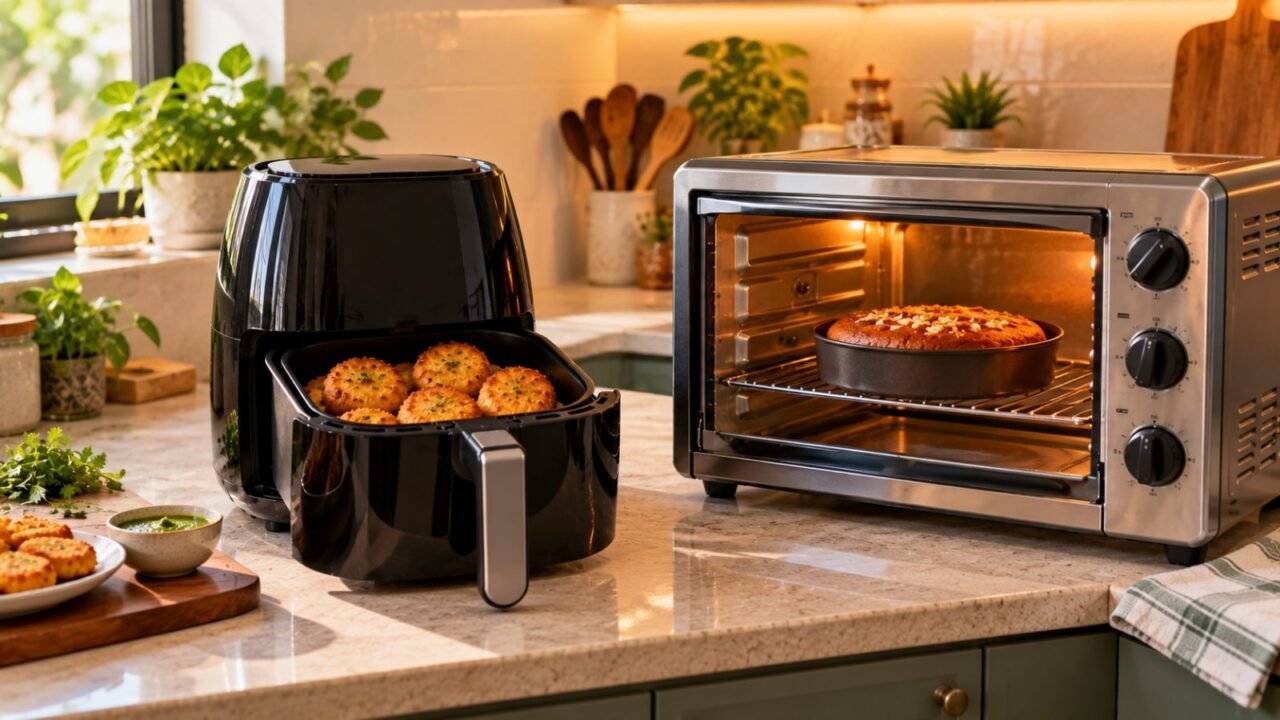
Walk into any appliance store and you will hear two opinions. One person swears by their air fryer for crisp snacks with hardly any oil. Another says an OTG is the “real oven” – it bakes cakes, makes pizza and grills a whole tray of paneer tikka. Both are right, because these two appliances are good at different things.
This guide compares an air fryer and an OTG (oven toaster griller) for everyday Indian cooking: what each one does well, how much it can hold, how fast it cooks, how much power it uses and how easy it is to clean. It is based on how the appliances work and on manufacturer specifications – we have not cooked side by side with these models ourselves.
The quick answer
- Choose an air fryer if you mostly want crisp snacks, reheating and quick sides for two to four people with minimal oil and effort.
- Choose an OTG if you want to bake cakes, cookies and bread, make pizza, or grill and roast larger batches.
- Many homes end up with both – the air fryer for daily snacks, the OTG for weekend baking and festival cooking.
Air fryer vs OTG: side-by-side
| Air fryer | OTG | |
|---|---|---|
| How it cooks | Strong fan blows very hot air around food in a small basket | Heating rods above and below a tray; some models add a convection fan |
| Best at | Crisp snacks, tikkis, fries, reheating, roasted vegetables | Cakes, cookies, bread, pizza, grilling and roasting large batches |
| Typical size | 3–7 litres | 9–60 litres |
| Preheating | Little or none | Usually 10–15 minutes |
| Speed for snacks | Faster | Slower |
| Baking | Small cakes and muffins only | Proper baking with even top and bottom heat |
| Typical power | 1200–2000 W | 800 W (small) to 2000 W+ (large) |
| Cleaning | Basket and tray; often easy | Tray, rack and inner walls; more effort |
| Counter space | Small | Medium to large |
Things You Need
- List of dishes you cook most often
- Counter space measurement
- Socket rating near the counter (16 A for 1500 W+)
Step-by-Step Instructions
-
Step 1: List what you cook every week
If most of it is snacks, tikkis and reheating, an air fryer will suit you. If baking, pizza or grilling for a crowd is on the list, lean towards an OTG.
-
Step 2: Count the people you cook for
For one to four people, a 4–5 litre air fryer is enough for snacks. For five or more, or for full-tray grilling, an OTG or a 6–7 litre air fryer works better.
-
Step 3: Measure your counter space
Air fryers need a small footprint. A 25 litre OTG needs more width and depth, plus space around it for heat to escape.
-
Step 4: Check your socket
Most air fryers and mid-size OTGs draw 1200–2000 W. Plug them directly into a suitable wall socket, ideally 16 A for higher-wattage models.
-
Step 5: Decide whether you need both
If you snack daily and bake often, owning both is practical: the air fryer for speed, the OTG for baking and big batches.
How an air fryer cooks
An air fryer is really a small, powerful convection oven. A heating element sits above the basket and a fan pushes hot air down and around the food at high speed. Because the cooking chamber is small, it heats up almost immediately and the moving air dries the surface of the food quickly – that is what gives you the crisp outside with a brush of oil instead of a kadai full of it.
It shines with the snacks Indian families eat every week: aloo tikki, cutlets, paneer and chicken tikka, fish fry, roasted chana and makhana, and reheating samosas or pakoras without them going soggy in a microwave. The limit is space. Food needs to sit in one layer to crisp evenly, so for a family of five you may cook in two or three rounds.
A popular example is the Philips NA120/00 (4.2 L, 1500 W). See more options in our best air fryers in India guide.
How an OTG cooks
An OTG has heating rods at the top and bottom of a box with a glass door. You choose which rods to use: both for baking, top only for grilling and browning, bottom only for slow cooking from below. Many models add a convection fan and a rotisserie for roasting.
That even, surrounding heat is what baking needs, so an OTG is the right tool for sponge cakes, cookies, bread, nankhatai and pizza. Its bigger tray also lets you grill a full batch of tikka or roast vegetables for the whole family in one go. The trade-offs are slower start-up (most OTGs need 10–15 minutes of preheating), more counter space and more cleaning.
Examples: the AGARO Marvel 25 L OTG lists a motorised rotisserie, adjustable temperature and five heating modes, and the compact Bajaj 1603 16 L OTG is a 1200 W model for smaller kitchens.
Which one should you buy? By what you cook
| You mostly want to… | Better choice |
|---|---|
| Make evening snacks like tikki, cutlets, fries | Air fryer |
| Reheat samosas, pakoras and leftovers so they stay crisp | Air fryer |
| Bake cakes, cookies, bread or nankhatai | OTG |
| Make pizza or garlic bread | OTG |
| Grill paneer or chicken tikka for 5–6 people at once | OTG (or a large 6–7 L air fryer) |
| Cook for one or two with minimum fuss | Air fryer |
| Roast a whole chicken | OTG with rotisserie |
| Save counter space | Air fryer |
Electricity use
Power use depends on wattage and how long the appliance runs. For a batch of snacks, an air fryer usually wins because it needs little or no preheating and cooks faster in its small chamber. A 1500 W air fryer running for 15 minutes uses about 0.4 units. A 1600 W OTG that preheats for 10 minutes and then cooks for 20 minutes uses about 0.8 units. At ₹7 per unit, that is roughly ₹3 versus ₹6 for the same snack.
For a large cake or a full tray of tikka, the comparison changes: the OTG cooks everything in one go, while an air fryer might need several rounds.
Cleaning and maintenance
- Air fryer: wash the basket and tray after each use, avoid metal scrubbers on the non-stick coating, and wipe the heating element area gently once it is cool, as your manual describes.
- OTG: use the crumb tray, line baking trays with butter paper, and wipe the inner walls when they are just warm. Do not spray cleaners directly on the heating rods.
Common myths
“An air fryer can replace an OTG.” Only for small jobs. It can bake a small cake or a few muffins, but it cannot match an OTG for proper baking or large batches.
“An OTG is the same as a microwave.” No. An OTG has no microwave function, so it cannot quickly heat a cup of milk or rice the way a microwave does. A convection microwave combines both but is a different product.
“Air-fried food has no oil.” You still need a little oil for colour and crispness. The saving is that you use spoons instead of a kadai full.
Final word
If your family’s routine is evening snacks, quick sides and reheating, an air fryer will get used every day. If you love baking, pizza nights or grilling for a crowd, an OTG is the better buy. If you can make space for both, they complement each other well – the air fryer for weekday speed, the OTG for weekend baking.
Frequently Asked Questions
1. Which is better for an Indian kitchen, an air fryer or an OTG?
It depends on what you cook. An air fryer is better for daily snacks, reheating and quick sides with little oil. An OTG is better for baking cakes, bread and pizza, and for grilling or roasting large batches.
2. Can an air fryer bake a cake?
Yes, a small cake or a few muffins in a suitable tin that fits the basket. For larger cakes, bread and cookies in batches, an OTG gives more even results.
3. Does an air fryer use less electricity than an OTG?
For small batches, usually yes, because an air fryer needs little preheating and cooks faster. For large batches, an OTG can be more efficient because it cooks everything in one go.
4. Can I make tandoori dishes in an OTG?
Yes. Grilling with the top rods, or using convection and rotisserie modes if your OTG has them, works well for paneer tikka, chicken tikka and tandoori vegetables.
5. Is an OTG the same as a convection microwave?
No. An OTG uses heating rods and has no microwave function. A convection microwave combines microwave heating with convection baking, so it can reheat quickly and also bake, but it is a different appliance.
Final Thoughts
Pick the appliance for the food you cook most. An air fryer suits families who want crisp snacks, quick sides and easy reheating with little oil. An OTG suits families who bake, make pizza or grill for a crowd. If you do both often, owning one of each is a practical combination.